
U.S. Midterm Elections – A National Rebuke to Trump
November 5, 2026
The U.S. Model
Congressional elections happen every two years. They are typically referred to as midterm elections, as they take place halfway between presidential elections. One-third of the Senate and every seat in the House of Representatives is up for election every time.
There are 435 seats in the House of Representatives, i.e. it takes 218 to control it. They all serve two-year terms, i.e. all seats are up for election every midterm and every presidential election year. The Senate has 100 seats – two senators from each state. Senators serve six-year terms, i.e. only one-third of the seats in the Senate were up for election.
The Americans also had other items on their ballots, but these two were the important ones in terms of the powers granted to the two parties and to President Trump.
The Concept of Gerrymandering
Gerrymandering, practised by both parties but often more aggressively by the party under electoral pressure, involves manipulating electoral boundaries to maximise political advantage by concentrating or dispersing opposition voters. While technically legal, the practice undermines democratic principles by creating safe seats and allowing a party to win a majority without securing the popular vote. The US Supreme Court effectively sanctioned the practice in 2019, ruling that challenges to partisan gerrymandering were beyond the remit of federal courts. As a result, the electoral playing field is heavily skewed: estimates suggest Democrats need around a four-point lead in the popular vote to win the House and potentially a double-digit margin to secure the Senate, making electoral outcomes far less predictable.
The Powers Granted to the Two Chambers
A majority in the House (but not the Senate) is important but probably not the top priority for the Democrats. The majority party in the House controls the legislative agenda – what and when? A majority also brings control of certain committees, control of the budget and control of fiscal legislation. However, majority in the Senate brings other powers which are very important to the Democrats. First and foremost, the Senate is responsible for appointing new Supreme Court justices, and Trump has used those powers in recent years to turn the U.S. Supreme Court substantially to the right. Appointments to the Supreme Court are life-long so cannot be changed by gaining a majority in the Senate, but at least the Democrats can stop further ‘radicalisation’.
It goes without saying that the #1 priority for the Democrats is to gain a majority in both chambers. This will allow the Democrats substantial control of the legislative agenda, and it will grant the party powers to shape the budget. Trump still holds a veto right, but his powers will be curtailed substantially without a majority in Congress. Barack Obama (in 2015-16) was the last U.S. president who had to deal with the opposition holding a majority in both chambers, and it was obvious how lame that made him.
Early Results
The Democrats have secured control of both chambers of Congress, following confirmation of their majorities in the House of Representatives and the Senate. This gives the party control of the legislative agenda for the forthcoming congressional term.
The Democrats taking control of the House has been on the cards for weeks, but the win in the Senate happened faster than expected and was more convincing than anticipated. Take a look at Exhibit 1. There used to be a massive red wall from the northwest to the southeast corner of the country. Although many states in that band remain red, seemingly impenetrable Republican states like Texas, Kansas and Iowa are suddenly blue. Kansas hasn’t been blue since 1932! It is also worth noting that the Republicans have not been able to flip a single state (yet).
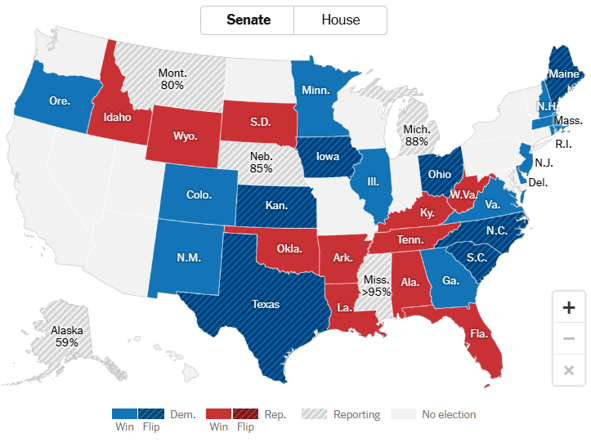
Exhibit 1: Results of the 2026 midterm elections for the Senate
Source: New York Times
So, what is Trump’s reaction? He gave a (brief) interview to the New York Times. He appeared to be rather subdued but said that he was willing to accept the result, and that he was prepared to work with the Democrats in Congress. He blamed Republican losses on the fact that he was not on the ballot, and called his decision to go to war with Iran a “very wise decision.” In true Trump style, he insisted that his first two years in the White House had been “the most successful two-year period in the history of any president”. Last but not least, he pledged to accept the results of the elections, and that was despite his sustained efforts to sow doubt about how reliable those elections are.
Financial Market Implications
Assuming Trump will stand by his words (which is not always the case), the risk of civil unrest in the weeks to come is probably quite low. That will energise equity investors, and we expect positive returns over the next few months, even if the initial reaction is likely to be more muted. Take a look at Exhibit 2. While U.S. equities have, on average, delivered muted returns heading into the midterms, returns the following 3, 6 and 9 months have been quite strong. Those very strong returns have happened regardless of who won the midterms. It is almost as if equity investors care more about the clarity on the makeup of Congress and its implications for fiscal policy than they care about who is in power.
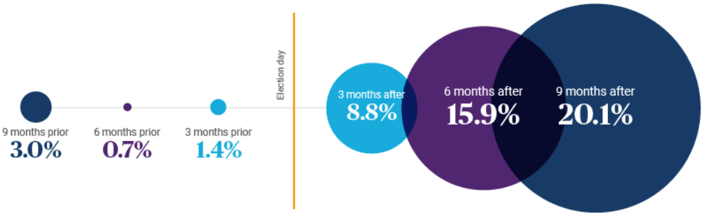
Exhibit 2: Total return, S&P 500, before and after past midterm elections
Note: Statistics based on end-of-calendar months
Source: ameriprise.com
We wish we could paint the same picture on the outlook for interest rates but that is not the case. Trump’s nickname is “the King of Debt” for a reason. Although he won’t be able to spend freely anymore, as he has been able to over the last two years, we believe the damage has already been done, and that significant rate hikes (in the order of 2-3%) shall be required to bring inflation back to 2%. And, for that reason, we don’t think equity returns in 2027 will land at the upper end of the range in Exhibit 2.
Risk Warning
This document has been issued by Quartet Capital Partners LLP (“Quartet”), which is authorised and regulated by the Financial Conduct Authority. The information in this document does not constitute, or form part of, any offer to sell or issue, or any offer to purchase or subscribe for shares, nor shall this document or any part of it or the fact of its distribution form the basis of or be relied on in connection with any contract. Quartet has not taken any steps to ensure that the securities referred to in this document are suitable for any particular investor and no assurance can be given that the stated investment objectives will be achieved. Quartet may, to the extent permitted by law, act upon or use the information or opinions presented herein, or the research or analysis on which it is based, before the material is published. Past performance is not a guide to future performance.
The law may restrict distribution of this document in certain jurisdictions; therefore, persons into whose possession this document comes should inform themselves about and observe any such restrictions. This letter, the information contained herein, and any oral or other written information disclosed or provided is strictly confidential and may not be reproduced or redistributed, in whole or in part, nor may its contents be disclosed to any other person under any circumstances.
Quartet Capital Partners LLP is a Limited Liability Partnership registered in England and Wales, Company No: OC345770.
Registered Office: 16 Water Lane, Richmond, Surrey, TW9 1TJ.
Authorised and regulated by the Financial Conduct Authority of the United Kingdom (“FCA”).
A list of members is available for inspection at the registered office.